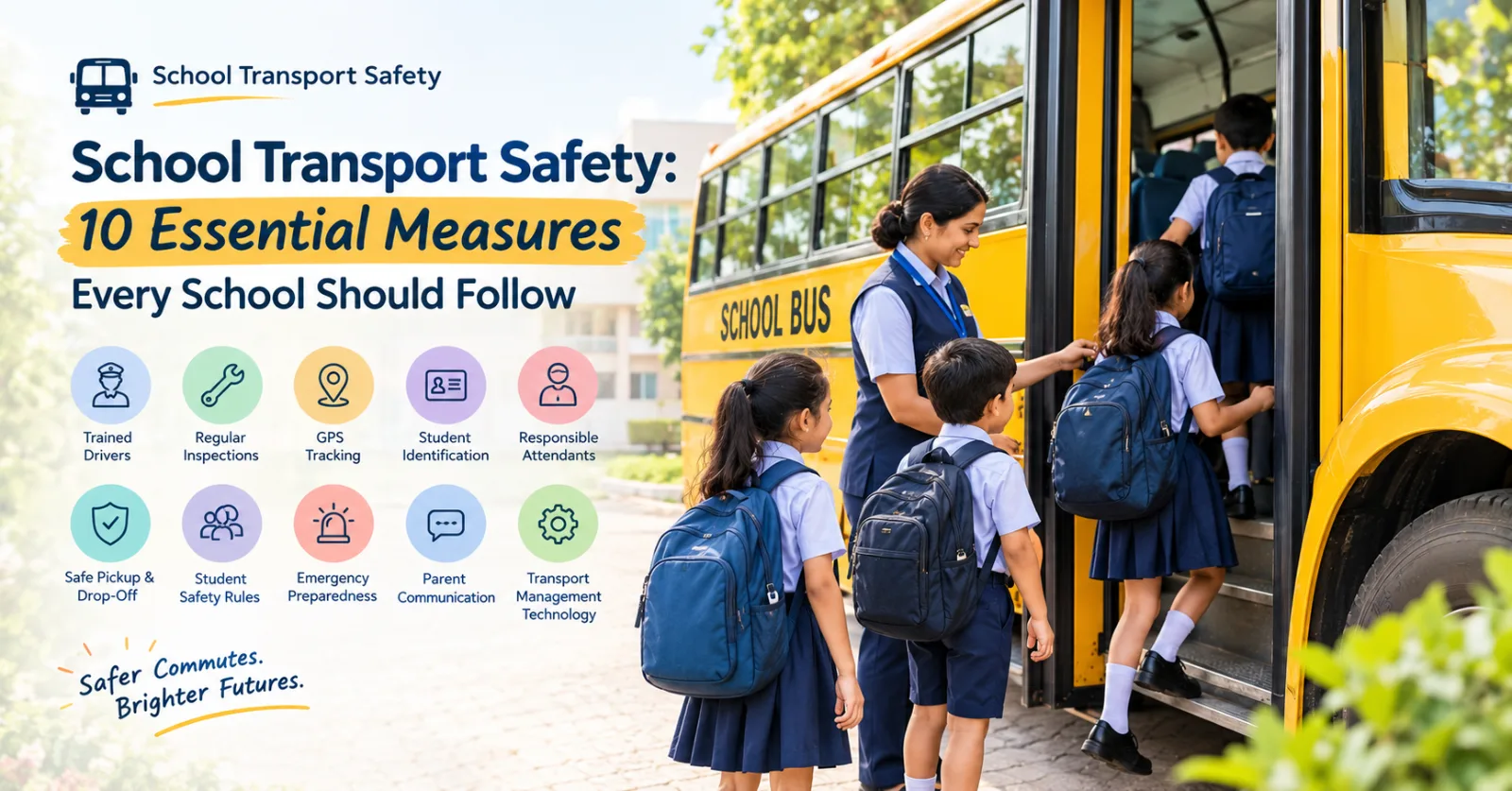
School Transport Safety: 10 Essential Measures Every School Should Follow
School transport safety is essential for protecting students during their daily commute. Discover 10 important school bus safety measures, including GPS tracking, student ID verification, trained drivers, regular vehicle inspections, emergency preparedness, and parent communication, to help schools
For many children, the school day begins long before they enter the classroom. It starts when they leave home and board their school bus or van. While school transportation makes daily commutes easier for students and parents, it also brings an important responsibility: ensuring every child travels safely.
School transport safety is not just about maintaining vehicles. It involves trained drivers, responsible attendants, proper student identification, real-time monitoring, emergency preparedness, and effective communication with parents.
Schools must adopt a structured approach to student transportation to minimise risks and build trust among parents. Even small improvements, such as maintaining accurate attendance records or checking that every child has safely boarded and exited the bus, can make a meaningful difference.
In this blog, we explore 10 essential school transport safety measures every school should follow to create a safer, more reliable, and more organised transportation system.
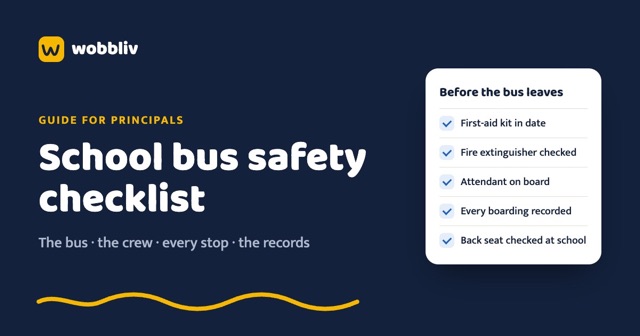
Also Read: School Bus Safety Checklist for Principals: A Practical Guide for Indian Schools
Why Is School Transport Safety Important?
School transportation involves several moving parts, including drivers, attendants, students, parents, school administrators, and transport service providers. A gap in communication or supervision can create unnecessary risks.
A strong school transportation safety system helps schools:
Protect students while boarding, travelling, and getting off the bus.
Reduce the risk of accidents and unauthorised access.
Keep parents informed about their child's commute.
Improve accountability among drivers and transport staff.
Respond quickly to emergencies and unexpected delays.
Build confidence in the school's overall safety standards.
With appropriate procedures and technology, schools can make transportation safer while improving the daily experience for families.
10 Essential School Transport Safety Measures Every School Should Follow
1. Hire Trained and Verified Drivers
The driver plays a crucial role in school bus safety. Schools should ensure that every driver meets the applicable licensing, background verification, medical fitness, and training requirements.
Drivers should receive regular training on defensive driving, road safety, traffic regulations, child behaviour, and emergency response.
Schools should also establish clear rules against speeding, distracted driving, mobile phone use while driving, and driving under the influence of alcohol or other impairing substances.
What schools should do:
Verify driving licences and required documents before employment.
Conduct background and reference checks as permitted by law.
Provide regular refresher training.
Monitor driving behaviour and investigate reported safety concerns.
Ensure drivers follow approved routes and traffic regulations.
A responsible, well-trained driver is one of the most important foundations of a safe school transportation system.
2. Conduct Regular School Bus Inspections
A school bus must be mechanically sound and suitable for transporting children. Even an experienced driver cannot prevent every risk if a vehicle has faulty brakes, damaged tyres, or malfunctioning safety equipment.
Schools and transport operators should follow a documented vehicle maintenance schedule and conduct inspections before buses begin their daily routes.
Important inspection points include:
Brakes, tyres, steering, and suspension.
Headlights, indicators, brake lights, and hazard lights.
Doors, emergency exits, and seat belts, where fitted or required.
Mirrors, windscreen, wipers, and visibility.
Fire extinguishers, first-aid kits, and other required emergency equipment.
Vehicle registration, fitness certification, permits, and insurance, as applicable.
Any vehicle with a critical safety defect should be taken off the road until the issue is resolved.
Preventive maintenance helps reduce breakdowns, supports compliance, and keeps students safer throughout their journeys.
3. Install GPS Tracking and Real-Time Bus Monitoring
Knowing where a school bus is during a journey can help schools coordinate transportation more effectively. A GPS-enabled school bus tracking system allows authorised school staff to monitor vehicle locations and identify route deviations or unexpected delays.
When integrated with suitable software, tracking can also support estimated arrival times and provide parents with relevant journey updates.
For example, if a bus is delayed because of heavy traffic, the school can communicate the delay rather than leaving parents uncertain about their child's arrival.
Benefits of GPS-based school transport monitoring:
Better visibility into bus locations.
Faster identification of route deviations.
Improved coordination between drivers and school administrators.
More timely communication with parents.
Easier review of reported transportation incidents.
Schools should choose systems with appropriate access controls, data protection measures, and clear rules governing the collection and use of students' location information.
GPS tracking is an important support tool, but it should complement—not replace—responsible driving, supervision, and emergency procedures.
4. Use Student Identification and Boarding Verification
One of the most important parts of school transport safety is confirming that the right student boards the correct vehicle and gets off at the authorised stop.
Manual attendance can be difficult to manage, particularly when buses have many students or multiple pickup points. Schools can strengthen their procedures with student ID cards, QR-code scanning, RFID cards, or other suitable identification systems.
A well-designed process should record student boarding and exit events and make relevant information available to authorised staff.
For instance, when a student boards the bus, the system can register their presence. When they reach their designated stop, a second verification can help confirm that the journey has been completed as expected.
Best practices for student identification:
Assign every student to an authorised route and pickup point.
Verify boarding and exit according to school policy.
Notify authorised staff when a student's expected boarding or exit is missing.
Keep student records updated when routes or authorised guardians change.
Establish a backup process for forgotten, damaged, or unavailable ID cards.
Technology can make attendance tracking more efficient, but schools must also train transport staff to handle exceptions and respond when a student cannot be accounted for.
5. Appoint Responsible Bus Attendants
Drivers need to concentrate on the road. A trained bus attendant can help supervise students, manage boarding and exit, and support communication with the school.
Where required by applicable rules, schools should ensure the prescribed attendant or escort arrangements are in place. Even where requirements differ, appropriate supervision is particularly important for younger children and students who need additional assistance.
Bus attendants should be trained to:
Help children board and exit safely.
Check student attendance and authorised drop-off arrangements.
Maintain order without distracting the driver.
Report unusual behaviour, injuries, or safety concerns.
Follow emergency evacuation procedures.
Ensure the bus is checked after every trip so no child is left behind.
Schools should clearly define the responsibilities of drivers and attendants instead of assuming that one person can manage every safety task simultaneously.
6. Establish Safe Pickup and Drop-Off Procedures
A child's journey does not end simply because the bus has reached the stop. Boarding and drop-off points can be risky when traffic is moving, visibility is poor, or children cross roads without supervision.
Schools should select designated stops that are accessible, reasonably well-lit where needed, and suitable for safe boarding and exit.
Essential precautions include:
Stopping only at authorised locations.
Ensuring the vehicle comes to a complete stop before students move.
Using designated boarding areas away from moving traffic wherever possible.
Training students to wait until it is safe to board or exit.
Following clear rules for road crossing.
Releasing younger children only according to the school's authorised handover policy.
Updating records when a parent or authorised guardian changes the pickup arrangement.
Parents should also know the correct pickup point and expected arrival time. A consistent handover procedure reduces confusion and makes it easier to identify unusual situations.
7. Train Students in School Bus Safety Rules
Children also have a role to play in keeping their journeys safe. Age-appropriate safety education helps students understand how to behave on the bus and around moving vehicles.
Schools should regularly explain and practise essential school bus safety rules, rather than relying only on a one-time orientation.
Students should be taught to:
Wait at a safe distance from the road until the bus arrives.
Avoid pushing, running, or fighting while boarding.
Use seat belts wherever provided or required.
Remain seated when the bus is moving.
Keep their hands, heads, and belongings inside the vehicle.
Avoid distracting the driver.
Follow the attendant's instructions.
Never approach the bus from an unsafe position or run behind it.
Inform a trusted adult if they feel unsafe or notice a problem.
Schools can reinforce these lessons through classroom discussions, demonstrations, posters, and periodic safety drills.
When students understand what to do, they become active participants in maintaining a safer transport environment.
8. Prepare for Emergencies and Unexpected Situations
Vehicle breakdowns, road accidents, medical emergencies, severe weather, and unexpected route closures can affect school transportation. Schools should prepare for these situations before they occur.
A written school transport emergency response plan should explain who is responsible for taking action, how parents will be informed, and where students should be taken if a journey cannot continue safely.
An effective emergency plan should include:
Emergency contact details for parents, school administrators, drivers, and attendants.
Procedures for accidents, breakdowns, and medical incidents.
Clearly assigned responsibilities for contacting emergency services.
First-aid supplies and trained personnel, as appropriate.
Safe evacuation procedures and designated assembly arrangements.
A process for accounting for every student.
Backup transportation and route-continuity arrangements.
Periodic drills and reviews following incidents.
Staff should know how to report an emergency promptly and provide accurate information. Emergency contact lists must be reviewed regularly to ensure they remain current.
A prepared school can respond more calmly and efficiently when unexpected situations arise.
9. Maintain Clear Communication with Parents
Parents want to know whether their child has boarded the bus, whether the journey is proceeding as expected, and whether the child has reached the designated stop.
Poor communication can create avoidable anxiety, especially when buses are delayed or transportation arrangements change unexpectedly.
Schools should establish a reliable communication process that keeps parents informed without overwhelming them with unnecessary notifications.
Useful communication features and practices include:
Notifications for relevant boarding and drop-off events.
Updates about significant delays or route changes.
Clear information about scheduled pickup and arrival times.
A designated contact point for transportation-related queries.
Timely messages during emergencies.
A process for reporting absent students or changes in authorised pickup arrangements.
A school bus tracking or transportation management platform can support these processes when configured appropriately.
Schools should also offer a practical alternative for parents who cannot access a smartphone or digital notification service.
Clear, timely communication strengthens parent confidence and helps schools manage transport-related concerns more efficiently.
10. Use School Transportation Management Technology
Managing multiple buses, routes, students, drivers, attendance records, and parent communications can become complicated as a school grows.
School transportation management software can bring important information together in one system, reducing reliance on scattered spreadsheets, paper registers, and separate communication channels.
Depending on the solution, useful features may include:
GPS-based vehicle tracking.
Digital student attendance.
Student ID or RFID-based verification.
Route and stop management.
Parent notifications.
Driver and vehicle records.
Incident reporting and journey logs.
Access controls and transport-related reports.
Before choosing a platform, schools should evaluate its reliability, ease of use, data security, privacy safeguards, support arrangements, and compatibility with their existing processes.
Technology should be selected according to the school's actual requirements, not simply the number of features advertised.
For schools looking to improve daily transport coordination, Wobbliv offers a school bus tracking and boarding-alert solution that helps schools monitor buses, verify student boarding, and keep parents informed about their child's journey. Its features include live bus location tracking, alerts for missed boarding or incorrect buses, and a central dashboard for school transport teams. By bringing these functions together, Wobbliv can help schools make student transportation more organised and transparent.
Additional School Transport Safety Checklist
Along with the ten measures above, schools should review the following checklist regularly:
Verify that vehicles meet applicable transport regulations.
Keep driver and attendant documentation up to date.
Maintain daily inspection and preventive maintenance records.
Confirm student lists, routes, and authorised pickup details.
Check that required safety and emergency equipment is available.
Review incident reports and address recurring problems.
Conduct periodic staff and student safety training.
Test communication and emergency response procedures.
Protect student records and restrict access to authorised personnel.
Review transport policies at the start of each academic year and whenever requirements change.
A documented checklist makes it easier to identify gaps and assign responsibility for corrective action.
School Transport Safety Rules in India
Schools operating in India should follow the applicable central and state regulations governing school transportation. Requirements can vary by jurisdiction and may cover vehicle fitness, permits, driver qualifications, attendants or escorts, safety equipment, and operational procedures.
The Supreme Court's school transport safety directions, the applicable provisions of the Motor Vehicles Act and Central Motor Vehicles Rules, and state-specific school bus rules are important reference points for compliance.
Schools should consult the relevant state transport department and education authorities to verify the requirements that apply to their vehicles and routes. They should also check for subsequent amendments or updated directions rather than relying on an outdated checklist.
Compliance should be treated as the minimum standard. Schools should additionally establish practical monitoring, communication, and incident-management procedures suited to their students' needs.
How Does Technology Improve School Transport Safety?
Technology can help schools move from reactive transport management to a more organised, proactive approach.
For example, a school that relies entirely on paper attendance records may find it difficult to confirm whether a student boarded the correct bus during a busy morning. A digital verification system can make the process easier to record and review.
Similarly, GPS tracking can help staff investigate route deviations, while parent notifications can reduce uncertainty when journeys are delayed.
However, no technology can guarantee complete safety on its own. The best results come from combining reliable systems with trained people, clear responsibilities, vehicle maintenance, and well-practised emergency procedures.
When evaluating a school transportation solution, schools should ask whether it helps them answer three essential questions:
Where is the bus? Vehicle tracking and route monitoring can improve visibility.
Where is the student in the journey? Boarding and exit verification can improve accountability.
Who needs to know? Timely alerts and communication workflows can help authorised staff and parents respond appropriately.
These capabilities can help schools build a transport system that is easier to monitor, manage, and improve.
Frequently Asked Questions (FAQs)
1. What are the most important school transport safety measures?
The most important measures include hiring trained drivers, inspecting vehicles regularly, monitoring routes, verifying student boarding and exit, supervising children, following safe pickup and drop-off procedures, teaching bus safety rules, preparing for emergencies, communicating with parents, and maintaining appropriate transport records.
2. How can schools ensure students board the correct school bus?
Schools can assign students to approved routes, maintain updated passenger lists, use ID cards or digital verification systems, and ensure attendants follow documented boarding procedures. Any mismatch should be investigated promptly.
3. Why is GPS tracking important for school buses?
GPS tracking helps authorised school staff monitor vehicle locations, identify route deviations, assess delays, and share relevant journey updates. It improves visibility but should not replace driver supervision or other safety measures.
4. How can parents help improve school bus safety?
Parents can ensure children reach pickup points on time, teach them safe bus behaviour, keep emergency contact information updated, follow authorised pickup procedures, and promptly inform the school about changes to transport arrangements.
5. What should a school bus emergency plan include?
An emergency plan should cover accident reporting, breakdowns, medical incidents, evacuation, student accountability, emergency contacts, parent communication, and backup arrangements. Staff should receive training and practise relevant procedures periodically.
6. Is school bus tracking software necessary for every school?
The most suitable approach depends on the school's size, routes, operational needs, and applicable requirements. Tracking software can improve visibility and coordination, but schools must also maintain sound safety procedures, trained personnel, and appropriate vehicle inspections.
7. How often should school buses be inspected?
Drivers and transport staff should carry out the required pre-trip checks, while more detailed inspections and preventive maintenance should follow the manufacturer's recommendations and applicable regulations. Any suspected safety defect should be addressed before the vehicle returns to service.
Conclusion
School transport safety requires consistent attention at every stage of a child's journey—from boarding the bus in the morning to reaching home in the afternoon.
By following these ten essential measures, schools can strengthen supervision, improve accountability, prepare for emergencies, and build better communication with parents.
The most effective approach combines trained staff, well-maintained vehicles, clear safety policies, reliable monitoring, and appropriate technology. Schools should regularly review their procedures, address identified gaps, and keep student welfare at the centre of every transportation decision.
A safer school commute is not achieved through a single device or policy. It is built through everyday actions, shared responsibility, and a commitment to making student safety a priority.
Looking to improve your school's transportation management? Explore solutions that support route monitoring, student identification, attendance verification, and parent communication to help make daily school commutes more organised and transparent.